Disclosure: This post contains affiliate links. We may earn a commission if you purchase through our links, at no extra cost to you.
Marketing ROI for a Shopify store isn't as simple as comparing ad spend to revenue. You need to account for cost of goods sold, Shopify transaction fees, return rates, and customer acquisition costs before you know whether a campaign actually made money. Most Shopify store owners see revenue going up and assume marketing is working, without realising their margins are being quietly eroded by inefficient ad spend, high return rates on the exact products being advertised, or payment processing fees that never show up in a top-line revenue number.
This distinction matters more the longer a store runs paid campaigns, because the gap between "revenue is up" and "we're actually more profitable" tends to widen as ad platforms get more competitive and cost-per-click creeps upward year over year. A store that never separates these two questions can end up scaling a channel that's quietly losing money on every order, simply because the top-line revenue chart keeps climbing.
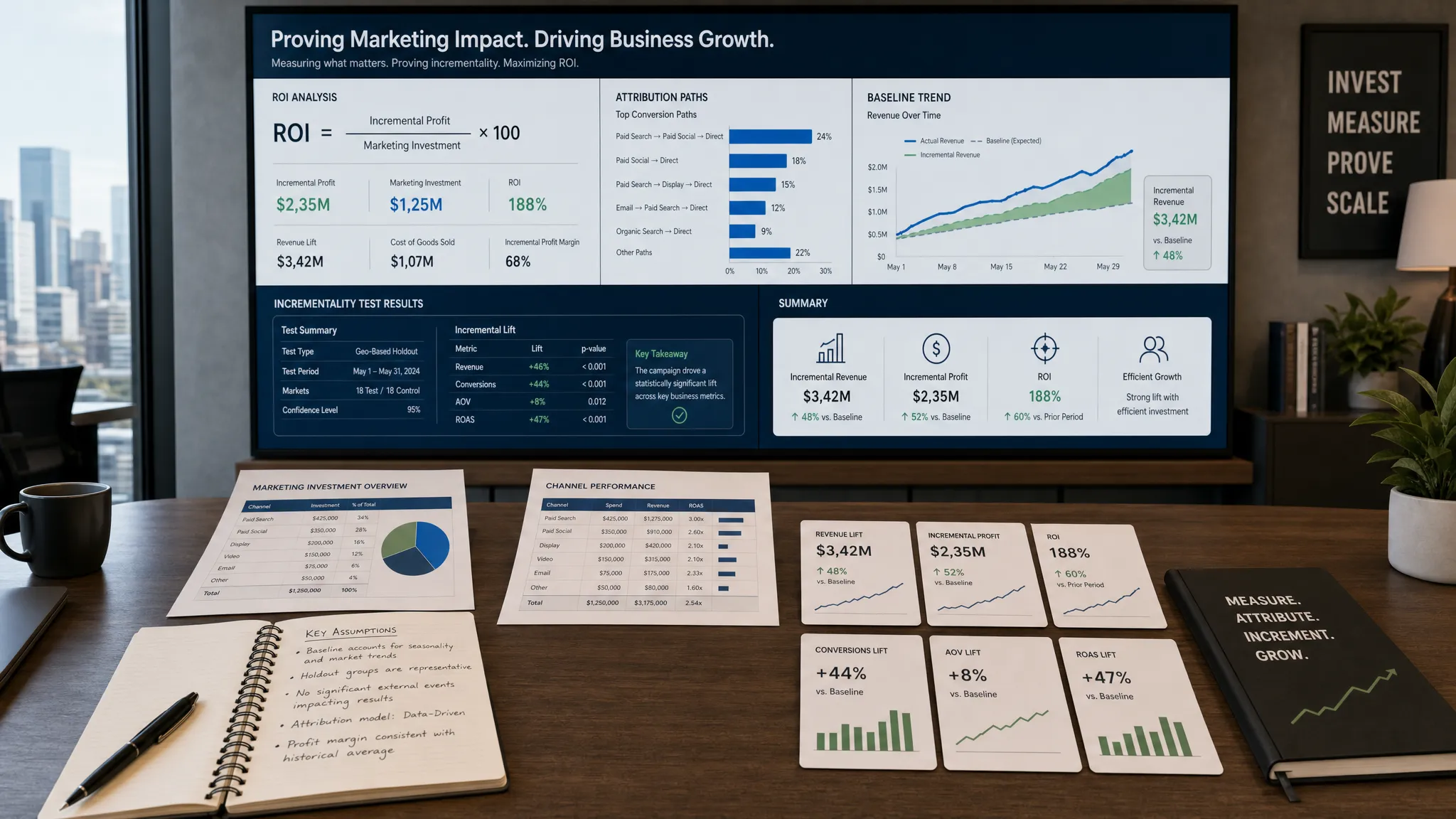
Basic marketing ROI: ROI = (Gross Profit − Marketing Spend) ÷ Marketing Spend × 100
Where Gross Profit = Revenue − Cost of Goods Sold
For a Shopify store spending $2,000 on Google Ads that generates $8,000 in revenue from products with a 60% margin:
Use the free calculator below to run these numbers without doing it manually. Free Marketing ROI Calculator — get your ROI, ROAS, and net profit instantly →
Extend the example above with a 12% return rate, which is a realistic figure for apparel. If $8,000 in revenue includes $960 in eventual returns, your effective revenue drops to $7,040. Gross profit at the same 60% margin becomes $4,224, and ROI drops to ($4,224 − $2,000) ÷ $2,000 × 100 = 111%. Still profitable, but meaningfully lower than the 140% figure that ignores returns entirely — and for a store with a 25–30% return rate, common in categories like shoes or fitted clothing, the gap between "revenue-based ROI" and "return-adjusted ROI" can be the difference between a channel that's profitable and one that isn't.
ROAS measures revenue generated per dollar spent on ads. ROI measures actual profit after costs. For Shopify stores with thin margins — common in apparel, accessories, and consumer goods — ROAS alone is misleading. A 4x ROAS sounds strong, but if your product margin is 25%, you're breaking even at best after ad costs, before you've even accounted for Shopify transaction fees, shipping subsidies, or payment processor cuts.
Always calculate both. Use ROAS for quick channel comparisons during the campaign — it's a simpler number to check daily and doesn't require pulling margin data every time. Use ROI for budget decisions, since it's the number that actually tells you whether to scale a channel, hold steady, or cut it.
Target ROAS depends entirely on your product margin, which is why a single "good ROAS" benchmark you read online is often the wrong number for your specific store:
Know your maximum allowable CPA before you launch any campaign, rather than discovering it after a month of spend has already gone out the door. Calculate your allowable CPA free →
It's worth internalizing why the ROAS targets above scale so steeply with margin: at a 70% margin, every dollar of revenue carries 70 cents of gross profit to absorb ad cost, so even a relatively low ROAS still nets a profit. At a 20% margin, every dollar of revenue carries only 20 cents of gross profit — meaning you need roughly five times the revenue per ad dollar just to break even. This is exactly why two stores can run the "same" campaign at the "same" ROAS and have wildly different outcomes: one is comfortably profitable, and the other is losing money on every sale.
Shopify's default attribution model is last-click, which overstates the contribution of retargeting ads (since a retargeting ad is often the last touchpoint before a purchase a customer had already decided to make) and understates top-of-funnel channels like organic social or influencer content that introduce a customer to your brand weeks before they buy. This distortion leads store owners to over-invest in retargeting and under-invest in the channels that actually generate new demand.
For more accurate attribution, tag every campaign with UTM parameters so Google Analytics can attribute sessions correctly to the actual source, medium, and campaign — not just whichever link a customer happened to click last. Without consistent UTM tagging, a huge share of traffic ends up misclassified as "direct" or "referral," which makes channel-level ROI calculations unreliable regardless of how carefully you track spend. Build properly formatted UTM URLs free →
Benchmarks by channel for Shopify e-commerce in 2026, useful as a sanity check against your own numbers rather than a target to hit exactly:
A few mistakes show up repeatedly when Shopify stores calculate ROI in-house. Ignoring Shopify's payment processing fees (typically 2.4–2.9% plus a per-transaction fee) understates true cost. Using gross revenue instead of gross profit overstates ROI dramatically for lower-margin products. Attributing a full month of ad spend to a single week of unusually high sales, rather than smoothing spend and revenue over a consistent period, produces misleading spikes. And comparing ROI across channels without adjusting for differing sales cycles — email converts existing customers fast, while SEO and content build demand slowly — leads to premature conclusions about which channel is "winning."
Before setting a Google Ads budget, reverse-engineer it from your conversion goal and target CPA rather than picking a round number that feels affordable. Working backward from the outcome you actually need keeps budget decisions tied to your margin math instead of gut feel. Use the free Google Ads Budget Calculator →
If you're still evaluating platforms, Shopify remains the most marketer-friendly e-commerce platform available — with the broadest set of integrations, the strongest app ecosystem, and the best native analytics for tracking the metrics in this post without needing a separate business intelligence tool bolted on from day one.
Start your free Shopify trial →
Yes, if you subsidize or offer free shipping — that cost comes directly out of gross profit and should be treated the same way cost of goods sold is treated in the formula above.
Weekly at minimum for active paid campaigns, since CPC and conversion rates can shift with competition and seasonality faster than most store owners expect. Monthly is reasonable for slower-moving channels like SEO.
Often lower than steady-state ROI, since platforms like Google and Meta need a learning period to optimize delivery. Many advertisers see ROI improve over the first 4–6 weeks as the algorithm gathers conversion data — which is a reason not to judge a new campaign's viability on week one alone.